How AI Is Transforming SEO Strategies in 2026 (And What You Must Do Now)
How AI Is Transforming SEO Strategies in 2026 (And What You Must Do Now)
Published: April 2026 | Reading time: 12 min | Level: Beginner-friendly
SEO is changing fast. And AI is the reason why.
In 2026, the old rules no longer work. Stuffing keywords into a blog post will not help you rank. Building hundreds of low-quality backlinks will not help either. In fact, those tricks can hurt you now.
So what does work?
In this guide, you will learn exactly how AI is changing SEO. You will also learn what steps you need to take today to rank on Google in 2026. This guide covers everything — from keyword research to Google's new AI search results.
Let's start from the beginning.
What Is AI in SEO? (Simple Answer)
First, let us explain what AI in SEO means.
AI stands for Artificial Intelligence. It is a type of smart computer system. It learns from data. Then it makes decisions on its own.
Search engines like Google use AI to decide which websites rank at the top. They look at your content. They check if it is helpful. They also check if real people trust your website.
In simple words: AI helps Google find the best answers for people — and rank those answers first.
Because of this, SEO has changed. You can no longer trick search engines. Instead, you must create real, helpful content that people actually want to read.
How Has SEO Changed in Recent Years? (2020 → 2026)
To understand where SEO is going, you need to know where it came from.
Here is a simple timeline:
2020 — Keywords Were King
Back in 2020, most SEO was about keywords. You picked a word. You used it many times in your post. Google ranked you for it.
Simple. But not very smart.
2022 — Google Got Smarter
Google launched big updates. These updates punished thin, low-quality content. Suddenly, websites with helpful, in-depth content started winning.
Google also began looking at E-E-A-T signals. That stands for:
- Experience — Has the writer done this before?
- Expertise — Does the writer know this topic well?
- Authoritativeness — Do other trusted websites link to you?
- Trustworthiness — Is your site honest and safe?
2023 — AI Content Exploded
In 2023, everyone started using AI tools to write content. ChatGPT became popular. Millions of new blog posts were published every day.
However, most of this AI content was generic and shallow. Google noticed. It updated its rules. Low-effort AI content started dropping in rankings.
(Many people asked: "How is AI going to affect content SEO strategies in 2023?" The answer was clear — only helpful AI content would survive.)
2024 — Google AI Overviews Arrived
Google launched AI Overviews (AIO). This was a huge change. Now, Google shows an AI-generated answer at the very top of search results — before any links.
This meant fewer people clicked on websites. Instead, they read Google's AI answer and left.
2026 — The New SEO Reality
Today, in 2026, SEO looks very different. Here is what matters most:
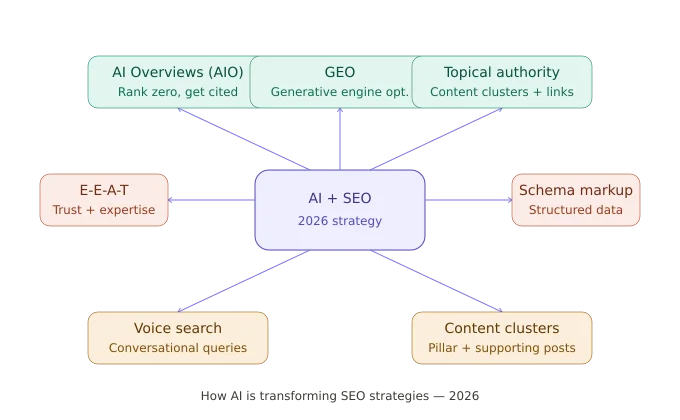
- Getting cited inside Google's AI Overviews
- Writing content that AI systems trust and reference
- Building topical authority across many related posts
- Optimizing for voice search and conversational queries
- Using structured data so AI can read your content easily
This is the new SEO. Let us go deeper into each part.
Google's AI Overviews (AIO) — The Biggest Change in SEO Right Now
This is the most important section of this guide. Please read it carefully.
What Are AI Overviews?
When you search on Google today, you often see a blue box at the very top of the page. Inside, Google's AI writes a short answer to your question. It pulls information from trusted websites.
This box is called an AI Overview (AIO).
The websites that get cited inside this box get massive visibility — even if they are not ranked #1.
How Has This Changed SEO?
Before AIOs, ranking #1 on Google was the goal.
Now, the new goal is getting cited in the AIO box — also called becoming "rank zero" or "position zero."
Studies show that:
- Over 60% of Google searches in 2026 now show an AI Overview
- Websites cited in AIO get a significant trust signal boost
- Click-through rates on traditional links have dropped in AIO-heavy searches
How Do You Get into Google's AI Overviews?
Here are the steps that work in 2026:
Step 1 — Write clear, direct answers. Start your answer within the first 100 words. Google's AI looks for answers that get to the point fast.
Step 2 — Use structured headings. Use H2 and H3 headings clearly. Ask a question in the heading. Answer it right below.
Step 3 — Add FAQ sections. Questions and answers at the end of your post are gold for AIO. Write them in plain, simple language.
Step 4 — Use schema markup. This is special code added to your website. It tells Google exactly what your content is about. We will explain this more below.
Step 5 — Build trust signals. Get links from other trusted websites. Make sure your author bio shows real expertise.
What Is GEO? (Generative Engine Optimization)
You have heard of SEO. But now there is a new term: GEO — Generative Engine Optimization.
GEO means optimizing your content so that AI-powered search engines (like Google's AI Overviews, ChatGPT search, and Perplexity) use your content in their answers.
Think of it this way:
- SEO = getting humans to click on your link
- GEO = getting AI systems to quote and trust your content
In 2026, you need both.
How to Optimize for GEO:
- Write factual, well-sourced content
- Include statistics and data points with clear citations
- Use clear definitions for every key term
- Write in a conversational, question-and-answer format
- Keep sentences short and easy to scan
How AI Will Affect SEO in the Next 3 Years
Many people ask: "How will SEO change with AI in the future?"
Here is what experts predict for 2026–2029:
1. Zero-Click Searches Will Keep Growing
More and more searches will end on Google's results page itself — without a click. Google's AI will answer the question right there.
Therefore, your goal must shift. Instead of only chasing clicks, focus on being the source that Google's AI quotes.
2. Voice Search Will Grow Fast
More people use voice assistants every day. They ask full questions like:
- "How is AI changing SEO strategies?"
- "What is the best way to use AI for SEO?"
These are conversational queries. They are much longer than typed searches. As a result, your content must answer full questions — not just match short keywords.
3. Search Will Become Personalized
AI will show different results to different people based on their history, location, and behavior. Consequently, ranking for one keyword will mean different things for different users.
The solution? Build a brand. When people search for your name or your website, it is a strong trust signal.
4. AI Agents Will Browse the Web for Users
In the near future, AI agents (like Google's Project Astra or OpenAI's Operator) will browse the web on behalf of users. They will look for answers and report back.
Therefore, your content must be machine-readable. Structured data, clear headings, and clean formatting are more important than ever.
How to Use AI to Improve SEO — A Step-by-Step Workflow
Now let us get practical. Here is exactly how to use AI tools to improve your SEO in 2026.
Step 1 — Use AI for Keyword Research
Start with a tool like Ahrefs, SEMrush, or Google Search Console. Then use AI (like ChatGPT or Claude) to:
- Find long-tail keyword variations
- Group keywords by search intent
- Identify content gaps your competitors have missed
Example prompt: "Give me 20 long-tail keywords related to 'how AI is transforming SEO strategies in 2026' with low competition."
Step 2 — Create a Detailed Content Brief
Before writing, build a content brief. Use AI to:
- Outline your post structure
- List all subtopics you must cover
- Identify the questions users are searching
Step 3 — Write with AI, Then Edit as a Human
Use AI tools to write a first draft. However, do not stop there. Go through every paragraph and:
- Add your own examples and experiences
- Remove anything that sounds generic
- Add current statistics and data
- Make sure the tone sounds human
This combination of AI speed + human editing is what ranks in 2026.
Step 4 — Optimize for Semantic Search
Semantic search means Google understands the meaning behind your content — not just the words.
Use tools like Surfer SEO or Frase to:
- Find related terms and phrases to include
- Check if your content covers the full topic
- Identify missing subtopics
Step 5 — Add Schema Markup
Schema markup is code that tells search engines exactly what your content contains. For blog posts, add:
- Article schema — tells Google it is a blog post
- FAQ schema — marks up your Q&A sections
- HowTo schema — marks up step-by-step guides
You can generate schema markup for free using Google's Structured Data Markup Helper.
Step 6 — Promote and Build Links
Great content still needs links. Use AI to:
- Find websites that might link to your content
- Draft outreach emails quickly
- Identify broken links on competitor sites you can replace
Step 7 — Track and Update Regularly
Finally, check your Google Search Console every month. Look for:
- Which posts are losing rankings
- New keyword opportunities
- Pages that need fresh, updated data
Then use AI to help you update those posts quickly. Fresh content gets a ranking boost.
SEO's New Identity in 2026 — From Keywords to Entities
Here is something most people do not talk about: SEO has a new identity.
It is no longer about keywords. It is about entities.
What Is an Entity?
An entity is a real "thing" that Google can identify. It could be:
- A person (Bill Gates, Elon Musk)
- A company (Google, Apple)
- A topic (Artificial Intelligence, SEO)
- A concept (machine learning, topical authority)
Google's AI understands the relationships between entities. For example, it knows that "SEO" is connected to "search engines," "keywords," "content," and "backlinks."
What Does This Mean for You?
Instead of optimizing a single post for one keyword, you must build topical authority.
Topical authority means covering an entire subject deeply — not just one angle. The more posts you write about AI and SEO (all linked together), the more Google sees you as an expert on the topic.
This is exactly why the internal linking structure matters so much. More on that below.
How AI Will Change Business — And What SEO Managers Must Know
This section is for business owners and marketing managers.
Many people ask: "How will AI change business?" The answer affects your SEO strategy directly.
AI Is Changing the Marketing Manager's Job
In 2026, a marketing manager's job looks different. Specifically:
- AI tools handle repetitive tasks (reporting, basic writing, scheduling)
- Managers spend more time on strategy and creativity
- Data analysis is faster — AI processes results in seconds
- Content production is faster — but quality control is now the critical skill
What About 2030?
Looking ahead, experts predict that by 2030:
- AI will handle up to 40% of routine marketing tasks
- SEO managers will focus more on brand strategy than keyword tactics
- Content teams will be smaller but more specialized
- The ability to interpret AI data and make smart decisions will be the top skill
Therefore, if you are an SEO manager or business owner, start learning AI tools now. The sooner you adapt, the bigger your advantage.
AI Content SEO: 2023 Predictions vs 2026 Reality
Back in 2023, many experts made predictions about how AI would change content SEO. Let us see how those predictions turned out.
| What Was Predicted in 2023 | What Actually Happened by 2026 |
|---|---|
| "AI will replace all content writers" | Human + AI hybrid content wins. Pure AI content often struggles to rank. |
| "Google will penalize all AI content" | Google penalizes low-quality content, not AI content specifically. |
| "Keywords will become useless" | Keywords still matter, but search intent and topics matter more. |
| "Voice search will dominate overnight" | Voice search grew, but slower than predicted. Now accelerating. |
| "Backlinks will stop mattering" | Links still matter — but quality now beats quantity by a wide margin. |
The lesson? AI did not kill SEO. Instead, it raised the bar. Only the best, most helpful content wins now.
How to Adapt Your SEO Strategy to AI — 7 Simple Rules
Finally, here are 7 simple rules to follow right now:
Rule 1 — Be helpful first. Write for humans. Rank because of it.
Rule 2 — Cover topics deeply. One post is not enough. Build a cluster of related posts that link to each other.
Rule 3 — Use AI as a tool, not a replacement. AI speeds up your work. Your judgment makes it good.
Rule 4 — Update old content. Fresh content wins. Go back to old posts. Add new stats. Fix outdated information.
Rule 5 — Build your E-E-A-T. Add author bios. Get expert quotes. Earn links from trusted websites.
Rule 6 — Optimize for answer boxes. Write clear, direct answers. Use FAQs. Add schema markup.
Rule 7 — Think long-term. SEO is not a sprint. It is a marathon. Consistent effort over 6–12 months beats any shortcut.
Frequently Asked Questions (FAQ)
How is AI changing SEO strategies in 2026?
AI is changing SEO in three big ways. First, Google now uses AI to generate answers directly on the search page (AI Overviews). Second, AI tools help marketers research, write, and optimize content faster. Third, Google's AI ranks content based on helpfulness and topic depth — not just keywords.
Will AI replace SEO?
No. AI will not replace SEO. Instead, it is changing what good SEO looks like. As long as people search for information online, SEO will matter. However, the skills needed are shifting — from keyword stuffing to topical authority, structured data, and user experience.
How will SEO change with AI in the future?
SEO will focus more on: getting cited in AI-generated answers, building topical authority across many posts, optimizing for voice and conversational queries, and using structured data so AI can read your content easily.
How do I use AI to improve my SEO?
Use AI tools (like ChatGPT, Surfer SEO, or Frase) for keyword research, content briefs, and first drafts. Then edit the content yourself to add real experience, examples, and accurate data. This human + AI approach is what ranks best in 2026.
What is topical authority in SEO?
Topical authority means your website covers an entire subject deeply — not just one post, but many related posts all linked together. When Google's AI sees that your site covers a topic from every angle, it treats your website as an expert source and ranks your content higher.
How to adapt AI into an SEO strategy?
Start by using best AI tools for SEO beginners in 2026 for research and drafting. Then build content clusters around your main topic. Make sure every post links back to a central pillar post. Use schema markup on all posts. And update your content every 3–6 months to keep it fresh.
How might AI change a manager's job in 2030?
By 2030, AI will likely handle most routine marketing tasks — reporting, scheduling, basic writing. Marketing managers will focus more on strategy, creativity, and interpreting AI data. The most valuable skill will be knowing how to use AI tools effectively while applying human judgment.
What is GEO (Generative Engine Optimization)?
GEO stands for Generative Engine Optimization. It means optimizing your content so that AI-powered search engines — like Google's AI Overviews, ChatGPT Search, and Perplexity — include your content in their generated answers. It works alongside traditional SEO, not instead of it.
What is SEO's new identity in 2026?
SEO's new identity is about entities and topical authority — not just keywords. Google's AI understands topics and relationships between ideas. So instead of optimizing one page for one keyword, successful SEO means building a connected web of content that covers an entire topic from many angles.
Conclusion — What You Should Do Next
Let us quickly recap what you have learned:
- AI is changing how Google ranks content — helpfulness and depth now win
- Google AI Overviews (AIO) are the biggest shift in search — optimize to get cited in them
- GEO (Generative Engine Optimization) is the new skill alongside traditional SEO
- Voice search and conversational queries are growing — write in natural language
- Schema markup helps AI read and trust your content
- Topical authority (a cluster of linked posts) beats a single long post every time
- The best content strategy in 2026 is: AI speed + human quality
Above all, remember this: SEO is not dying. It is evolving. The businesses that adapt to AI now will dominate Google rankings in 2026 and beyond.
Start with one action today. Pick one section from this guide. Apply it to your most important blog post. Then track your results.
Because in SEO, action always beats waiting.
Found this guide helpful? Share it with your team. And check out our related posts on AI SEO tools, link building in the age of AI, and why your AI content isn't ranking.
Referral link


Comments
Post a Comment